
Koh Tao Dive Sites
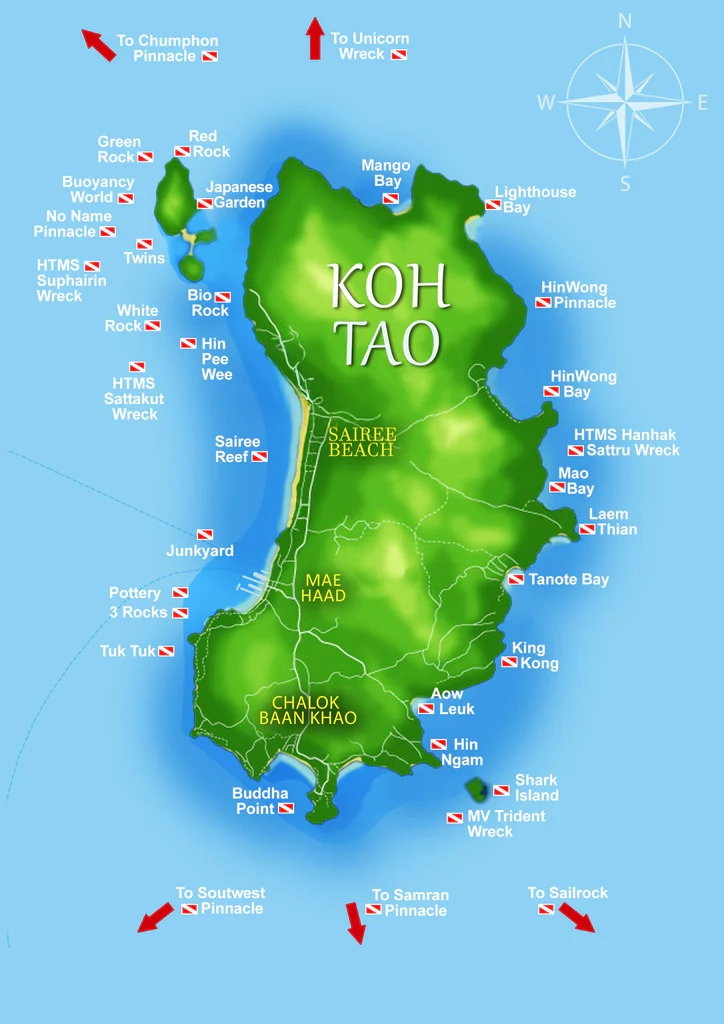
An interactive map of Koh Tao’s dive sites — from shallow bays to deep wrecks.
Click on a dive site to see its location, depth, experience level, and what makes it worth diving. Use the map to choose the right site for today’s conditions and your experience level.
Koh Tao Dive Sites
Sail Rock
Sail Rock is hard to miss, with a rocky pinnacle breaking the surface out in open water. The dive usually starts shallow, dropping through a natural chimney before opening up around the rock below. It’s a great place to take your time, with green moray eels and coral-banded shrimp often hiding in the cracks. The site is easy to swim around, and on the right day you might be lucky enough to see something big pass through.
Southwest Pinnacles
Location: About 7 km Southwest of Koh Tao
Depth: Average 17 m / Maximum 28 m
Level of Diving: Beginner to Experienced Divers
A line of rocky pinnacles creates a mix of walls and swim-throughs, with plenty of fish moving around the site. Snapper, trevally, and barracuda are often seen schooling along the edges, while the shallower sections are covered in sea anemones. As you move deeper, the landscape changes, with gullies lined by soft corals and long whip corals swaying in the current.
Chumphon Pinnacle
Location: About 5 km northwest of Koh Nang Yuan
Depth: Average 20 m / Maximum 36 m
Level of Diving: Experienced Divers
This deeper pinnacle is usually dived by more experienced divers, but in good conditions it can also be reached on the final day of an Open Water course. The scale of the rock formations gives the dive a big, open feel, with plenty to look at as you move around the site. Larger fish are often part of the picture here, and every now and then, there’s the exciting possibility of a whale shark passing through.
Shark Island

Location: 1 km off the southern tip of Koh Tao
Depth: Average 15 m / Maximum 28 m
Level of Diving: Beginner to Experienced Divers
Shark Island gets its name from the shape of the rocks above water, which look a bit like a shark fin from the right angle. When there’s some current, the site really comes alive, with plenty of marine life moving through. In the shallower areas, you’ll often see groupers, turtles, and schools of raccoon butterflyfish, while the eastern side is a great place to slow down and look for nudibranchs.
White Rock
Location: Western side of Koh Tao
Depth: Average 16 m / Maximum 28 m
Level of Diving: Beginner to Experienced Divers
White Rock is one of Koh Tao’s most popular sites and works well for both day and night dives. It’s known for resident titan triggerfish, which can be a bit territorial at certain times of year, so it’s worth keeping an eye out. The site is made up of layered rock shelves that shelter groupers, long-spined urchins, and plenty of anemones, with soft corals, hard corals, and colourful Christmas tree worms scattered throughout. If you enjoy underwater photography, White Rock offers lots of easy compositions and a good mix of marine life to work with.
Twin Peaks
Location: Western Side of Koh Nang Yuan
Depth: Average 10 m / Maximum 18 m
Level of Diving: Beginner to Experienced Divers
Around the three rocky pinnacles, you’ll find plenty to look at, from black sea cucumbers and boulder corals to large barrel sponges covered in long white tubeworms. Between two of the shallower pinnacles, a Clark’s anemonefish family lives tucked inside a ring of shells, making it a nice spot to slow down and watch what’s going on. Just north of the middle pinnacle is Buoyancy World, an alternative area designed to spread divers out from nearby Twins. Here you’ll see simple artificial structures that encourage fish and coral growth, along with buoyancy features often used to help newer divers build confidence and control.
HTMS Sattakut Wreck
Location: 30 m from Hin Pee Wee
Depth: Average 18 m / Maximum 30 m
Level of Diving: Experienced Divers
The HTMS Sattakut is one of Koh Tao’s best-known wreck dives and a favourite with more experienced divers. This former WWII landing craft was deliberately sunk in 2011 to create an artificial reef and now rests upright on the seabed. The lower part of the wreck sits deeper in the sand, while the mast rises up into shallower water, giving the dive a nice sense of scale as you move around it. Because of the depth, it’s best suited to advanced divers, but the site is easy to navigate and very rewarding. Just nearby lies Hin Pee Wee, making it common to combine the wreck with a second dive full of fish life, including fusiliers, barracuda, snappers, wrasse, and groupers.
Green Rock
Location: North-West of Koh Nang Yuan
Depth: Average 12 m / Maximum 30 m
Level of Diving: Beginner to Experienced Divers
A spectacular dive site northwest of Koh Nang Yuan offering adventurous swim-throughs provided by large archways, caverns, caves and crevices which cut through the submerged, bouldering rocks.
Home to the yellow margin triggerfish, divers may encounter a ‘trigger- attack’ during the spawning season, as they become very territorial and protective over their nests, which makes for an exciting dive.
Red Rock
Location: North-East of Koh Nang Yuan
Depth: Average 12 m / Maximum 20 m
Level of Diving: Beginner to Experienced Divers
This pinnacle rises from deeper water up toward the surface, with plenty of cracks and crevices shaped by years of erosion. It’s a good place to look for stingrays resting on the sand, as well as turtles and scorpionfish tucked into the rock. Heading back toward Koh Nang Yuan, there’s often a titan triggerfish hanging around the base of a small cave. The narrow cavern itself sits shallow, but it’s only suitable for divers with proper cavern training, so it’s best admired from the outside unless you’re qualified.
Hin Wong Pinnacle
Location: East Coast of Koh Tao
Depth: Average 12 m / Maximum 26 m
Level of Diving: Beginner to Experienced Divers
The east coast dive sites are quieter and feel very different from the west side of Koh Tao. These deeper pinnacles are covered in blue soft sponges, colourful sea fans, and long sea whips that give the area a softer look. A resident hawksbill turtle is often found resting under a ledge here, along with porcupine pufferfish and angelfish moving slowly around the rocks.
Aow Leuk
Location: South-East of Koh Tao
Depth: Average 6 m / Maximum 12 m
Level of Diving: Beginner to Experienced Divers
Aow Leuk is a sheltered bay with beautiful views and calm conditions, making it a great place to spot juvenile marine life. Its shallow, sandy bottom is home to garden eels, scorpionfish, and other bottom dwellers, while scattered coral boulders attract butterflyfish, sergeant majors, and passing schools of yellowtail barracuda.
Mango Bay
Location: North of Koh Tao
Depth: Average 5 m / Maximum 16 m
Level of Diving: Beginner to Experienced Divers
Mango Bay is a natural breeding ground for small reef fish, with reefs lining both the eastern and western sides of the bay and coral boulders scattered in between, forming the coral garden seen today. Calm, clear conditions make it ideal for snorkellers and beginner divers, allowing an easy transition from shallow sandy areas to deeper, rockier contours. Its beauty and pristine conditions also attract dive operators from neighbouring islands.
Japanese Gardens
Location: East of Koh Nang Yuan
Depth: Average 6 m / Maximum 16 m
Level of Diving: Beginner to Experienced Divers
Located on the east side of Koh Nang Yuan, Japanese Gardens sits beside one of the world’s rare sandbars connecting three teardrop-shaped islands. With excellent snorkelling and gentle conditions, it’s an ideal site for beginner divers. Sandy areas allow new divers to settle their buoyancy before moving onto the reef, where juvenile marine life is abundant. Expect blue-ringed angelfish, moon wrasse, damsels, and chromis, with porcupine pufferfish tucked into the crevices. On occasion, the distinctive black-and-white banded sea snake also makes an appearance.
Buoyancy World
Location: North-West of Koh Tao (near Twins Pinnacle / Koh Nang Yuan)
Depth: Average 6 m / Maximum 12 m
Level of Diving: Beginner to Experienced Divers
Buoyancy World is Koh Tao’s dedicated artificial training site, located on the north-west side of the island near Twins Pinnacle. Created by the local diving community, the site provides a safe, low-impact environment for practising buoyancy and core dive skills without putting pressure on natural reefs.
Set in shallow, calm water with a sandy bottom, Buoyancy World is ideal for beginner training, refreshers, and relaxed skill-focused dives. The site features underwater sculptures, hoops, and small swim-throughs used for buoyancy and navigation practice, which also act as coral nurseries. Over time, it has developed into a growing artificial reef, attracting batfish, wrasse, parrotfish, and other reef species.
Junkyard
Location: West of Mae Haad Bay, Koh Tao
Depth: Average 8 m / Maximum 12 m
Level of Diving: Beginner to Experienced Divers
Junkyard Reef is a shallow artificial dive site created from donated structures such as old gym equipment, vehicles, and custom-built frames. Designed as a coral nursery and reef restoration project, it provides shelter for marine life while reducing pressure on natural reefs.
Calm conditions and shallow depths make Junkyard Reef ideal for beginner divers, training dives, buoyancy practice, and night dives. Over time, it has developed into a thriving habitat where divers regularly see filefish, juvenile sweetlips, boxfish, clownfish, and a variety of reef critters. Its unusual layout offers a very different visual experience compared to Koh Tao’s natural reefs, while actively supporting conservation efforts.
Pottery
Location: South-West of Mae Haad Bay
Depth: Average 6 m / Maximum 12 m
Level of Diving: Beginner to Experienced Divers
Pottery Pinnacle, often simply called Pottery, is an easy and popular dive site located just minutes from Mae Haad Pier. The site consists of small rocky pinnacles and boulders rising from a sandy bottom, making it well-suited to shallow, relaxed dives.
With depths ranging from just a few metres to around 12 metres, Pottery is ideal for beginner divers, Open Water training, and night dives. While visibility can vary, the site offers plenty to explore, including blue-spotted stingrays, pufferfish, angelfish, bannerfish, pipefish, and occasional seahorses. The rocks are covered in hard corals and often hide small reef life.
Pottery Pinnacle is frequently dived together with nearby Three Rocks, making it a convenient and varied option for short dives close to shore.
3 Rocks
Location: South-West of Mae Haad Bay
Depth: Average 8 m
Level of Diving: Beginner to Experienced Divers
Three Rocks is an easy dive site made up of large boulders and shallow swim-throughs, located just a few minutes from Mae Haad Pier. Its compact layout and gentle depth profile make it well-suited to novice divers, training dives, and relaxed fun dives.
The site supports a mix of hard corals and sponge growth, including mushroom corals, giant barrel sponges, and giant clams. Marine life commonly seen includes butterflyfish, angelfish, longfin bannerfish, anemonefish, red-breasted wrasse, parrotfish, and blue-spotted stingrays. Small critters such as wart slugs are often found tucked among the rocks.
Three Rocks is frequently paired with nearby Pottery Pinnacle, offering an easy, varied dive close to shore.
Tanote Bay
Location: East coast of Koh Tao
Depth: Average 8 m / Maximum 18 m (up to 20 m in deeper areas)
Level of Diving: Beginner to Experienced Divers
Tanote Bay is a popular and scenic dive site on the east coast of Koh Tao, offering a mix of natural coral reef and artificial structures in calm, sheltered conditions. With a gentle slope from shallow sand to deeper reef, it’s suitable for a wide range of experience levels and is commonly accessed by both boat and shore dives.
The site features several artificial reef attractions, including a sunken catamaran resting at around 18 metres and a shallow motorbike, both of which attract a variety of marine life. Divers can expect to see large barrel sponges, brain coral, staghorn and boulder corals, along with angelfish, butterflyfish, triggerfish, turtles, and occasional schools of yellowtail barracuda. Banded sea kraits and macro life are also regularly spotted.
Tanote Bay combines easy diving with interesting features, making it a popular choice for training dives, relaxed fun dives, and snorkelling alike.
Laem Thian
Location: East coast of Koh Tao
Depth: Average 10 m / Maximum 35 m+
Level of Diving: Beginner to Experienced Divers
Laem Thian is a varied dive site on Koh Tao’s east coast, known for its large granite boulders, swim-throughs, and cavern systems. The shallow bay area is suitable for beginners, while the northern section features deeper caves and is better suited to experienced divers with good buoyancy control.
Divers commonly encounter blue-spotted stingrays, moray eels, pufferfish, schools of yellowtail barracuda, and titan triggerfish. Occasional sightings include green turtles, banded sea kraits, bumphead parrotfish, and a variety of macro life.
Hin Wong Bay
Location: North-East coast of Koh Tao
Depth: Average 8 m / Maximum 20 m (Hin Wong Pinnacle up to 40 m)
Level of Diving: Beginner to Experienced Divers
Hin Wong Bay is a sheltered dive and snorkel site on the north-east coast of Koh Tao, known for its granite boulders, coral reefs, and calm conditions within the bay. The shallow main bay is ideal for beginners and Open Water training, while the offshore Hin Wong Pinnacle offers deeper, more advanced diving for experienced divers.
The underwater landscape is formed by fused granite rocks creating cracks, crevices, and small swim-throughs, particularly along the southern side of the bay. Marine life is abundant, with large schools of fusiliers, parrotfish, rabbitfish, and sergeant majors commonly seen, along with blue-spotted stingrays, moray eels, pufferfish, and turtles. Occasional sightings include banded sea kraits, nudibranchs, and blacktip reef sharks in the shallower areas.
Hin Wong Bay offers a good balance of easy diving, rich marine life, and the option to progress to deeper diving nearby.
Lighthouse Bay
Location: North-Eastern point of Koh Tao
Depth: Average 4 m / Maximum 14 m
Level of Diving: Beginner to Experienced Divers
This sheltered bay on the north-east tip of Koh Tao offers shallow, calm diving that’s ideal for Open Water divers and snorkellers. Conditions are generally gentle with little to no current, except during the north-east monsoon season around October and November.
The site is known for its healthy coral formations, including large table corals, staghorn and brain corals, and barrel sponges. Extensive anemone fields shelter pink anemonefish, while schools of yellowtail barracuda, parrotfish, angelfish, butterflyfish, and groupers are commonly seen. Occasional sightings include turtles, blue-spotted stingrays, and blacktip reef sharks.
A short swim north of the bay leads to a deeper pinnacle, adding variety for certified divers and offering additional marine life and nudibranch sightings.
HTMS Suphairin

Location: West of Koh Nang Yuan, near No Name Pinnacle
Depth: Average 26 m / Maximum 28 m (mast rising to approx. 16 m)
Level of Diving: Advanced Open Water and above
HTMS Suphairin is one of Koh Tao’s newest wreck dive sites, intentionally sunk in September 2023 to create an artificial reef and underwater training site. Formerly a Royal Thai Navy fast attack craft, the wreck now rests upright on a sandy seabed and is clearly visible from mid-water.
At nearly 45 metres long, the wreck remains largely intact, with deck guns, superstructure, and open swim-throughs offering controlled wreck exploration. The upper sections are accessible to less experienced certified divers, while the deeper areas are better suited to advanced divers with good buoyancy control.
Marine life has established quickly, with schools of yellowtail barracuda, trevally, and fusiliers commonly circling the wreck. Giant groupers, snapper, boxfish, and nudibranchs are often seen around the structure, making Suphairin both an exciting dive and a growing artificial reef.
No Name Pinnacle
Location: West of Twins Pinnacle, near Koh Nang Yuan (north-west Koh Tao)
Depth: Average 20 m / Maximum 30 m
Level of Diving: Advanced Open Water and above
No Name Pinnacle is a deep granite pinnacle located west of Twins Pinnacle, offering quieter diving and the chance to encounter larger pelagic species. Rising from sandy bottom to around 14 metres, the site is best suited to experienced divers due to its depth and occasional current.
The pinnacle is formed by large granite boulders with cracks and swim-throughs between them, providing an interesting structure to explore. Marine life includes moray eels, scorpionfish, groupers, nudibranchs, and Jenkins whiprays resting on the sand. In open water, divers may encounter queenfish, Spanish mackerel, and on rare occasions, whale sharks.
The HTMS Suphairin wreck lies just north of No Name Pinnacle, making the two sites a popular combination for advanced and wreck-focused dives.
Hin Pee Wee

Location: North-West coast of Koh Tao (between HTMS Sattakut and White Rock)
Depth: Average 18 m / Maximum 28 m
Level of Diving: Advanced Open Water and above
Hin Pee Wee is a granite pinnacle dive site on the north-west coast of Koh Tao, named after one of the island’s early diving pioneers. Less crowded than nearby sites, it’s often dived as a natural extension to the HTMS Sattakut wreck and offers varied terrain with ledges, cracks, and swim-arounds.
The main pinnacles rise to around 8–9 metres and drop to sandy areas below, making the deeper sections best suited to experienced divers. Marine life is rich, with sea fans, whip corals, barrel sponges, and frequent sightings of white-eyed moray eels, blue-spotted stingrays, turtles, and banded sea snakes. Schools of barracuda and snapper are common, while careful observers may spot scorpionfish, nudibranchs, and other macro life.
Hin Pee Wee is a relaxed but rewarding advanced dive, offering excellent marine life and a quieter alternative to Koh Tao’s busier sites.
Sairee Reef

Location: West coast of Koh Tao (Sairee Beach)
Depth: Average 4 m / Maximum 10 m
Level of Diving: Beginner to Experienced Divers
Sairee Reef is a long, shallow fringing reef that runs parallel to Sairee Beach, Koh Tao’s longest beach. Easily accessed from shore, it’s one of the island’s most commonly used sites for beginner training, snorkelling, relaxed fun dives, and night dives thanks to its calm, shallow conditions.
The reef features a mix of boulder, brain, table, and soft corals, supporting a wide range of reef life including butterflyfish, angelfish, parrotfish, rabbitfish, and anemonefish. Nudibranchs, white-eyed moray eels, and blue-spotted stingrays are often seen, while night dives reveal different activity, including hunting barracuda. At the northern end of the reef lies the Hin Fai BioRock project, an artificial reef designed to support coral restoration.
Sairee Reef is an easy, accessible site ideal for building confidence and enjoying shallow reef life close to shore.
HTMS 313 (Suphairin)
Location: West of Koh Nang Yuan, near No Name Pinnacle
Depth: Average 26 m / Maximum 28 m (mast rising to approx. 16 m)
Level of Diving: Advanced Open Water and above
HTMS 313 (Suphairin) is one of Koh Tao’s newest wreck dive sites, intentionally sunk in September 2023 to create an artificial reef and underwater training site. Formerly a Royal Thai Navy fast attack craft, the wreck now rests upright on a sandy seabed and remains largely intact.
The wreck offers clear structure, deck guns, and open swim-throughs, making it suitable for controlled wreck exploration. Marine life has established quickly, with schools of barracuda, trevally, fusiliers, and resident groupers commonly seen around the wreck, along with smaller reef fish and nudibranchs.
HTMS 313 is frequently combined with No Name Pinnacle, offering an excellent advanced and wreck-focused dive combination.
HTMS Hanhak Sattru (Hull No. 312)

Location: East coast of Koh Tao (Aow Mao / Mao Bay, north of Laem Thian)
Depth: Average 23 m / Maximum 24 m (mast rising to approx. 13 m)
Level of Diving: Advanced Open Water and above
HTMS Hanhak Sattru (Hull No. 312) is a former Royal Thai Navy fast attack craft, intentionally sunk in September 2023 to create an artificial reef and reduce pressure on natural coral sites. It is the sister ship to HTMS Suphairin (313), located on the opposite side of the island.
The wreck lies upright on a sandy bottom and remains largely intact, making it well suited for controlled wreck exploration and first-time wreck penetration training. Its shallower profile allows divers to explore the structure comfortably while maintaining good depth awareness.
Marine life has established quickly, with schools of snapper, fusiliers, and bannerfish commonly seen moving through the wreck. Giant groupers, trevally, and barracuda patrol the area, while closer inspection reveals boxfish, nudibranchs, and small crustaceans settling along the structure.
Conditions change with the weather and season, so dive sites are always chosen on the day for safe, relaxed diving.
If you’re not sure which dives suit you best, our diving courses can help you build confidence and find the right pace.
If you’d like a hand choosing dives or courses, feel free to get in touch — we’re always happy to help.